The science.
Every choice in Wild Inside starts from how cats see and hunt.
What the research says, and what the app does.
- Sight
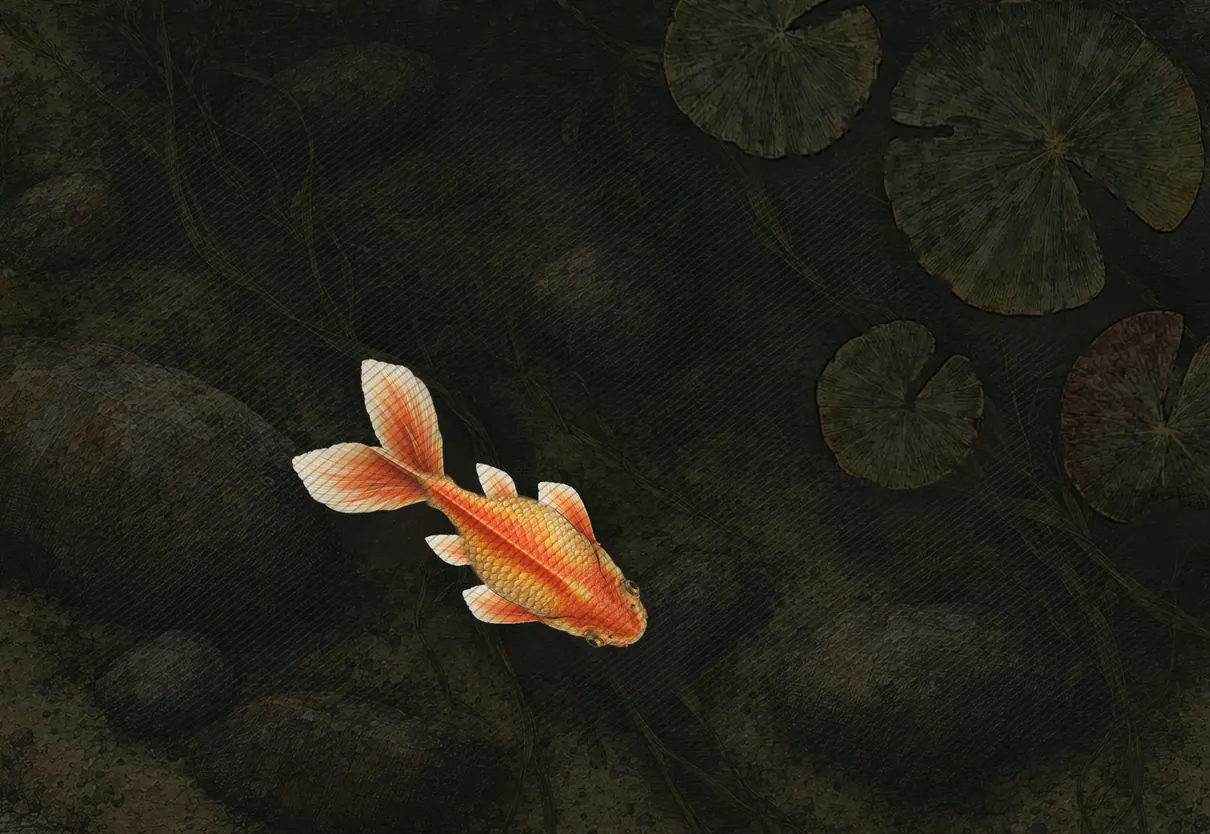
Cats see blue and yellow, and judge prey by brightness.1 So the prey is pale on a dark, still ground.
- Motion
Their eyes follow slow movement best.2 So the prey creeps, stops and darts, like the real animal.
- The catch
In one review, a toy that could never be caught drew the least interest.3 So every hunt ends with their catch, then a real treat.
- Variety
In one study, a different toy after a short break brought play back.4 So Guided Play rests, then changes the prey.
- Meals
Hungrier cats play harder.5 So hunts fall just before their meals.
- Older cats
Most cats over twelve still play at hunting.6 So hunts can be slow, short and easy to win. If their play drops off, tell your vet.7
- Limits
No study yet shows a welfare benefit from screen play alone, which is why every hunt ends with real food or a real toy. It’s one game among several, beside a wand, a kibble chase and a scented kicker.
Plate I. Their view
Sources
- Loop, Millican & Thomas 1987, J Physiol, pubmed 3625560; Loop & Bruce 1978, pubmed 628838. The app’s 80% contrast target is its own, built on these.
- Pasternak & Merigan 1980, pubmed 7430476; Donaghy 1980, J Physiol, pubmed 7381791.
- Ellis 2009, J Feline Med Surg (a review), PMC11383019.
- Hall, Bradshaw & Robinson 2002, Appl Anim Behav Sci 79:263, ScienceDirect. The new toy also smelled different; a screen can change only sight and sound.
- Hall & Bradshaw 1998, Appl Anim Behav Sci 58:143–150, doi.
- PDSA Animal Wellbeing (PAW) Report 2024: 61% of UK cats over twelve play predatorily with toys, owner-reported. PDSA.
- AAFP Senior Care Guidelines 2021, PMC10812122.